
Composite Deck Installation in Greenville, SC: The Frame Decides the Deck
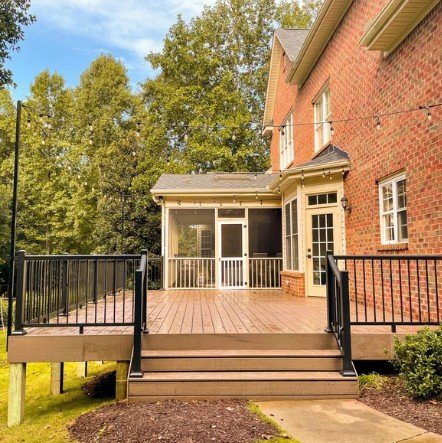
Homeowners choose composite deck installation in Greenville, SC by the board, and then live for years with a decision that was made underneath it. The boards are the part a household picks, while the frame is the part that determines how those boards look in year eight.
Stephen Osteen founded Paramount Outdoor Living in 2013. Our team has built decks across Greenville and the Upstate long enough to know that composite is a different material from wood in the ways that matter structurally. It moves more with temperature, carries load differently along its length, and usually fastens with a hidden clip rather than a screw through the face.
A frame designed for pressure-treated decking and then topped with composite is one of the most common reasons a deck develops waves.
Related: Choosing a Deck Company in Greenville, SC: The Questions That Separate Two Quotes
What Does Composite Decking Ask of the Frame Beneath It?
Composite decking asks for tighter joist spacing, consistently flat joist tops, and blocking wherever the boards change direction.
Most capped composite lines call for joists at sixteen inches on center for a straight lay and twelve inches for a diagonal one. A picture frame border needs its own support under every mitered edge, so the frame gets drawn around the board pattern rather than the other way around.
Flatness matters more than it does with wood. A thick wood board will bridge a slight dip in the framing, while composite follows the frame it sits on. That is why the joist tops get checked against a string line, then planed or shimmed true before a single board goes down.
How Does Upstate South Carolina Humidity Change a Composite Deck Build?
Upstate humidity changes what happens under a composite deck more than what happens on top of it. Composite boards do not rot, so the vulnerable parts are the pressure-treated frame and the ledger connection to the house. Both sit in a climate that stays damp for long stretches.
A well-built deck answers that with flashing at the ledger, joist tape over the framing where water collects at the fasteners, and a frame kept off standing contact with masonry.
The underside stays ventilated. A deck that traps moisture against the house fails at the wall long before the surface shows anything.
Related: What Separates a Quality Deck Builder in Greenville, SC
Does Composite Decking Run Hotter Than Wood in Full Sun?
Darker composite boards do run hotter than wood in full sun, and in Greenville that is a siting question rather than a reason to avoid the material. Our designers look at where the deck faces, what shades it in the afternoon, and how the household plans to use it before recommending a color.
A lighter board on a west-facing elevation stays comfortable through a Carolina afternoon. Put the same deck under a pergola or an existing tree canopy and the color range opens up considerably, because the shade does the work that a pale board would otherwise have to do.
How Are Composite Deck Boards Fastened, and Why Does That Matter?
Most capped composite decks are fastened with hidden clips that sit in a groove along each board edge.
The clip sets the gap as it goes, which keeps the spacing even as boards expand and contract through a long Upstate summer. It also leaves the surface free of screw heads that would otherwise collect water or discolor.
Face screwing is reserved for the spots a clip cannot reach, such as the outer edge of a picture frame border or the first and last boards. Those screws get covered with color-matched plugs so the surface reads as one finish.
How Long Does Composite Deck Color Hold?
Capped composite lines generally carry fade and stain warranties measured in decades, and real-world performance in the Upstate tracks that reasonably well. The honest caveat is that a deck weathers as a whole rather than board by board.
A board under a planter or a rug ages differently from the board beside it, and a corner that stays shaded weathers differently from one in full sun. Our team talks through furniture layout and planter placement during design so those differences are planned rather than discovered.
Planning a Composite Deck for Next Season
Our custom deck team works through framing, fastening and board selection as one set of decisions rather than three, which is what keeps a deck flat and even years after the install week. Starting now leaves room for design before the spring calendar fills.
Start your composite deck installation with Paramount Outdoor Living.
In Summary
Can composite boards go over an existing deck frame in Greenville?
Reusing an existing frame depends entirely on what the frame measures. Paramount Outdoor Living pulls a board and checks joist spacing, span and the condition of the ledger before quoting a reboard. A frame built at wider spacing for thicker wood decking usually needs joists or blocking added, and a frame with any rot in the ledger gets replaced rather than covered.
How far ahead should an Upstate homeowner start a deck project?
Design takes a few weeks on a larger project, and engineering, permitting and any HOA review follow after that rather than running alongside it. For a deck a household wants to use by late spring, starting the conversation in autumn is comfortable, while starting in March is tight.
Does a composite deck need sealing or staining?
Capped composite is finished at manufacture, so the maintenance is washing rather than sealing or staining. What it does need is clear drainage under the boards and open gaps between them, which are design decisions made during installation rather than something a homeowner corrects later.